Research becomes useful to an institution when its findings can be tested against operating conditions and turned into a decision with an owner and a review point.
Executive summary
A well-supported recommendation can still be difficult to implement. It may leave the decision-maker without a realistic account of costs, authority or delivery constraints. Evidence-based practice brings research into conversation with organisational data and the people who understand the work. For governments and businesses managing cross-border exposure, the task is to establish what the evidence supports, where it may not transfer, and what would justify changing course.
A recommendation needs a route into practice
A report recommends diversifying suppliers. The board agrees. Yet the alternative supplier has not been tested at the required volume, its invoices use a different currency, and the procurement team lacks authority to approve the switch. This is an illustrative decision problem, but it exposes a common weakness in recommendations: the conclusion can be clear while the route to implementation remains unresolved.
Windear’s concern is the distance between understanding an exposure and being able to act on it. Research should help an institution decide what to protect, what to test and where to commit resources. That requires attention to the conditions under which a recommendation would work.
Theory has a useful role here. It helps explain mechanisms and identify questions worth asking. Local evidence then tests whether those mechanisms operate as expected in the organisation facing the decision. Either can be misleading when used without the other.
Evidence includes the organisation doing the work
A 2026 study by Frank Bezzina, Vincent Cassar and Denise Rousseau developed a measure of how decision-makers use four evidence sources: scientific research, organisational data, professional expertise and stakeholder influence. The measure concerns reported evidence use; it does not establish the quality or effectiveness of a particular decision. For an adviser, the distinction matters: citing several sources is only the beginning of assessing an option.
A multinational assessing a technology provider, for example, needs more than an industry forecast. It should examine its own switching costs and service requirements, consult the people who would manage a transition, and establish how the change would affect users. Professional judgement helps interpret the evidence, but it also needs scrutiny.
The research-practice gap is therefore partly a problem of how knowledge is produced and communicated. A 2024 Business Horizons article by Ernest O’Boyle, Martin Götz and Damian Zivic argues for closer collaboration between researchers and practitioners. It is a useful challenge to advisers: involve the people who face the decision early enough to shape the question, rather than asking them to accept a finished answer.
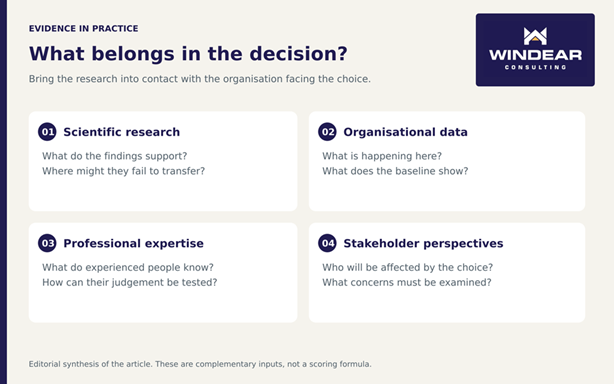
Research gains practical value when it is examined alongside organisational conditions and the people affected by a decision.
How leaders actually use knowledge
A 2014 NIHR study by Davide Nicolini, John Powell and Maja Korica followed seven NHS chief executives in England. Conducted between March 2011 and May 2013, the research combined observation, interviews and document analysis to examine how executives stayed informed in their daily work.
The CEOs rarely searched for and quoted formal research themselves. However, they did ask others to consider it. Conversations, professional relationships and organisational routines helped them interpret information and make sense of emerging problems. Reading this as evidence that managers simply disregard research would miss an important part of the findings.
The study was exploratory and specific to its setting. Its practical lesson for an adviser is about delivery: understand who gathers evidence, who tests it and how it reaches the person responsible for the decision. A technically sound report can contribute little if it bypasses those routines.
Promotion decisions show why the distinction matters
The published 2019 study Promotions and the Peter Principle, by Alan Benson, Danielle Li and Kelly Shue, examined 38,843 sales workers across 131 US firms, including 1,553 workers promoted into management. It found that strong sales performance increased the likelihood of promotion, although the characteristics associated with selling well were not necessarily those associated with managing others well.
The authors also recognised a trade-off. Promotion can reward effort and sustain incentives, even when it produces a weaker managerial match. Their findings do not justify treating every such promotion as an irrational mistake.
For an institution, the useful question is which abilities the next role requires. A promotion policy should make that distinction explicit and assess whether its selection criteria predict performance in the new job.
Gallup’s January 2026 article on US frontline supervisors adds a related observation. It reports that 65% obtained their role through frontline performance or experience, compared with 30% selected through supervisory skills, supervisory experience or a career beginning in supervision. Engagement was 31% in the first group and 42% in the second. These are reported associations, not proof that selection criteria alone caused the difference.
Gallup also reports that 45% had received supervisory training in the previous year, while 23% had never received it. This gives an organisation a more concrete starting point than a general instruction to improve leadership: review selection criteria and investigate the preparation supervisors actually receive.
A tested model at a specific mine
McKinsey’s 2023 account of its work with Freeport-McMoRan describes a team of metallurgists, operators and engineers developing an AI model at the Bagdad mine in Arizona. Operators tested recommendations against their knowledge of the plant and helped identify flaws during development.
The account reports a 5% increase in copper production over the following months. Separately, it reports that processing throughput in one quarter exceeded 85,000 metric tons of ore per day, 10% above the previous quarter. Production and throughput are different measures and should remain separate when the case is cited.
This is a consultancy’s account of an engagement, not an independent impact evaluation. The useful operational detail is the involvement of people who understood the asset. They could challenge the model’s recommendations before those recommendations became routine practice.
Put the decision and its constraints on one page
For a government agency weighing a technology investment, or a business reviewing supply-chain exposure, a decision brief can bring the analysis into focus. Windear proposes five questions.
- What decision is required, who has authority to make it, and by when?
- Which findings are well supported, and which assumptions still need testing locally?
- Can the preferred option work within the available budget, legal requirements and delivery capacity?
- Who owns implementation, and what must happen before the next step can begin?
- What evidence would justify continuing, changing or stopping the plan?
These questions should reveal disagreements while there is still time to investigate them. A supplier alternative may look attractive on price but fail on delivery capacity. A technology investment may promise efficiency while creating a dependency that the organisation cannot readily reverse. Such possibilities belong in the assessment before commitment.
The starting point is a baseline: what happens now, what the change is expected to improve, and how that improvement will be assessed. Where feasible, a limited test can expose delivery problems before resources are committed at scale. The review should also record what remains uncertain, so that a later change of course can be explained.
Our analysis of global supply chains applies this concern to sourcing and resilience. The wider principle is to connect an assessment of external conditions with evidence about the organisation’s ability to respond.
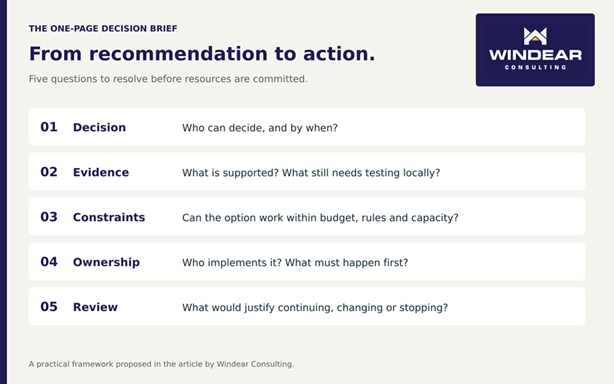
A usable decision brief makes the choice, evidence, constraints, implementation owner and review point explicit.
The next decision
Before commissioning another report, identify the choice it must support. Ask what evidence could change that choice and who will use the findings. A research engagement can then be designed around an operational question with a realistic path to action.
Bring Windear the decision you face, the exposure behind it and the deadline. The work begins by establishing what needs to be known before you commit.
Sources
Benson, A., Li, D., and Shue, K. (2019). Promotions and the Peter Principle. The Quarterly Journal of Economics, 134(4), 2085–2134. Published study.
Bezzina, F., Cassar, V., and Rousseau, D. M. (2026). Evidence-based management in practice: measuring the use of four core sources of evidence. International Journal of Organizational Analysis. Article.
McKinsey & Company. (2023, June 22). Freeport-McMoRan turns data into value. Case account.
Nicolini, D., Powell, J., and Korica, M. (2014). Keeping knowledgeable: how NHS chief executive officers mobilise knowledge and information in their daily work. Health Services and Delivery Research, 2(26). Scientific summary.
O’Boyle, E. H., Götz, M., and Zivic, D. C. (2024). Increasing the practical relevance of management research: In honor of Timothy T. Baldwin. Business Horizons, 67(2), 161–171. Article.
Tatel, C., and Stewart, A. (2026, January 7). When good frontline workers make bad supervisors. Gallup. Research article.