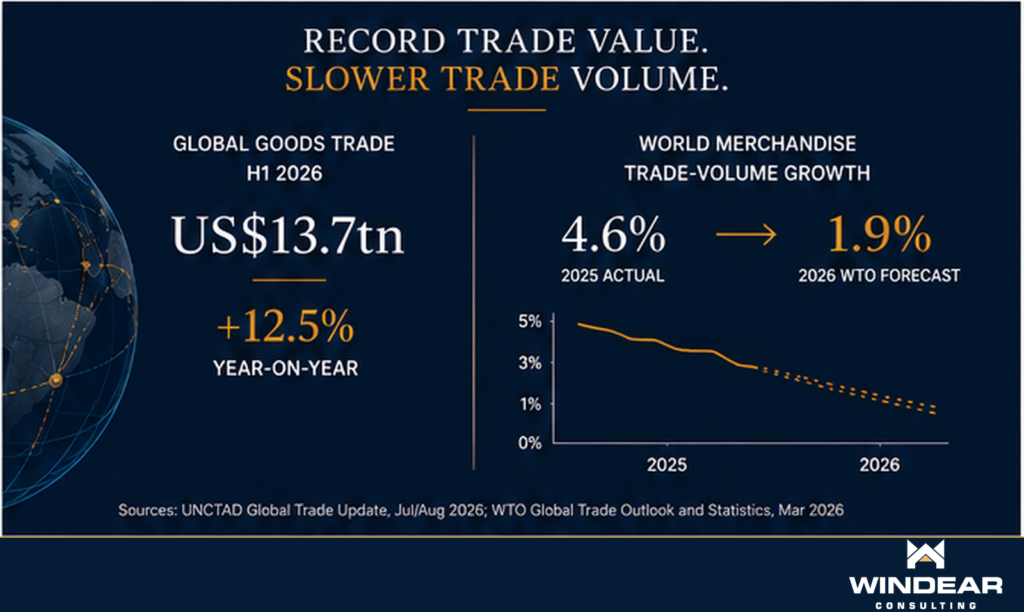
Trade values hit a record in the first half of 2026 while trade volumes are forecast to grow at less than half last year’s rate. The gap between those two numbers is the story.
Executive summary
Two numbers describe the first half of 2026. UNCTAD puts global goods trade at about US$13.7 trillion, up 12.5% year on year and on course for a record. The WTO expects merchandise trade volume to grow 1.9% this year, down from 4.6% in 2025. Value is setting records; volume is decelerating. The difference is price, and the price is disruption.
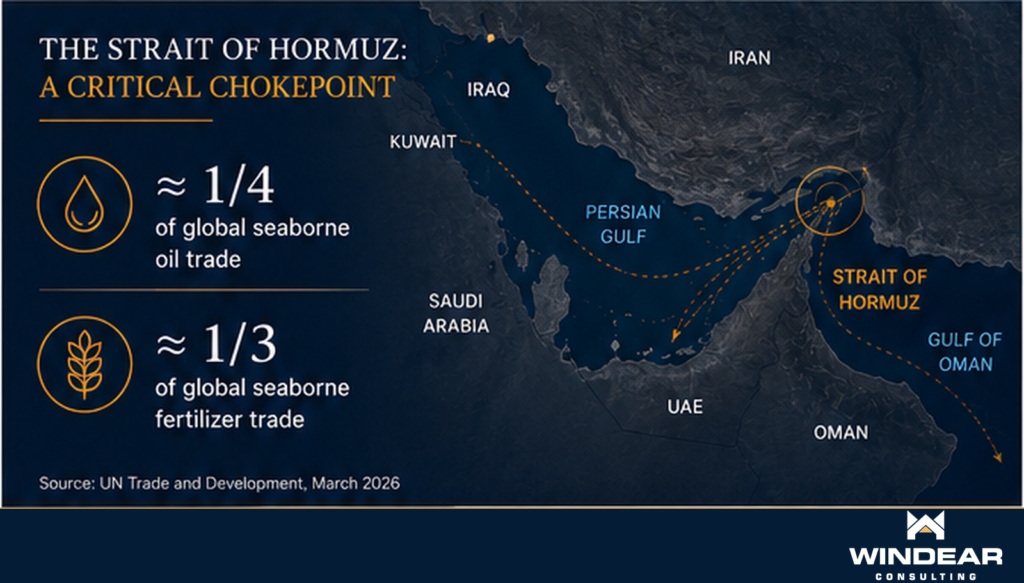
Most of that disruption runs through one waterway. The Strait of Hormuz, which carries roughly a quarter of seaborne oil and a third of seaborne fertiliser, has not worked normally since late February. Across the twelve strategic products UNCTAD tracks for the economies that depend on it, export volumes fell 54% between April 2025 and April 2026.
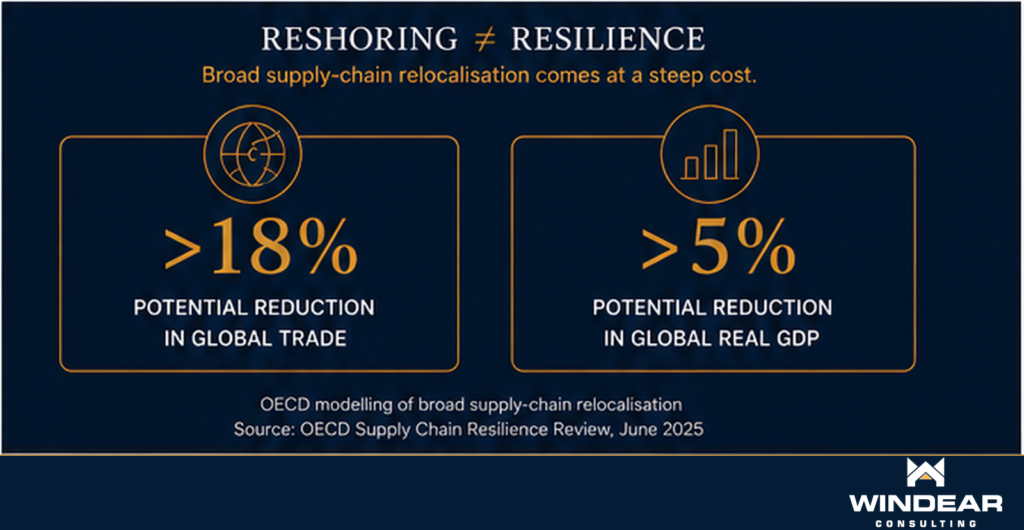
Cost and speed still decide most sourcing, but they now compete with security of supply, political alignment and the ability to keep operating when a strait or an export control interrupts trade. This is not a retreat from globalisation. Global value chains still carry around 70% of international trade, and OECD modelling finds relocalising them would cut global trade by more than 18% and real GDP by more than 5% while raising volatility in over half the economies tested. The response that works is narrower: qualified alternatives, regional options, and buffers where failure would be intolerable. For countries seeking a larger role in global supply chains, the opening is not lower cost. It is reliability: predictable at the border, connected inland and usable across blocs.
The question is no longer where production is cheapest. It is which network keeps delivering when the route, the rule or the relationship changes.
Efficiency still decides most sourcing. It no longer settles the decisions that matter
The pre-pandemic model rewarded concentration: production went where scale, labour and supplier density produced the lowest unit cost, and ran lean. Six years of shocks exposed what that model was carrying. Governments now treat selected supply chains as instruments of economic security, and tariffs, subsidies, screening and local-content rules shape location decisions alongside wages and freight. The obvious response has limits the OECD is blunt about: indiscriminate reshoring is expensive and does not reliably make systems more resilient. Resilience comes from finding the few points that cannot be allowed to fail, and building options there.
Four forces rewiring the geopolitics of global supply chains
1. Political alignment is reordering trade, selectively
WTO research using blocs derived from UN General Assembly voting found goods trade between hypothetical East and West blocs grew about 4% more slowly than trade within them after February 2022, with no general shift towards regionalisation or near-shoring. That gap stabilised through 2023 and 2024, then widened again in 2025. The system is fragmenting along political lines rather than reorganising around geography, and the WTO now puts the share of world trade conducted on a most-favoured-nation basis at 72% as of end-February 2026. More than a quarter of world trade already runs on terms set outside the multilateral rulebook.
Alignment determines access to technology, finance, procurement and strategic inputs. A supplier can stay commercially competitive and become legally unusable within a week when an export restriction or sanctions designation lands.
2. Chokepoints are an operating cost, not a scenario
Hormuz has not functioned normally since late February 2026, long enough to move macro numbers. Across UNCTAD’s twelve tracked products, LNG exports fell 95%, urea 83%, methanol 80% and ammonia 75%; crude oil exports fell by 28 million tonnes. UNCTAD expects global merchandise trade growth in real terms to slow from 4.7% in 2025 to between 1.5% and 2.5% this year, on a 2025 base it estimates separately from the WTO’s 4.6%.
The finding worth acting on is about substitution. Alternative suppliers raised shipments for ten of the twelve products but fully replaced the lost volume for only two: ammonia and polypropylene. UNCTAD’s reading is that markets covered the rest from inventories, domestic production, or reduced consumption. Few firms are building two complete supply chains; they are building graded redundancy, a primary supplier and a qualified alternative. What separated the firms that coped from the rest was whether that alternative had ever run at volume.
The contrast is visible by country. Japan had sourced 91% of its crude oil imports from Hormuz-dependent economies and saw those imports fall 64% in April; Korea and Malaysia were similarly exposed. Thailand’s rose 62% in the same month as refiners secured alternative cargoes. That was not luck. It was having somewhere else to buy from, already tested.
3. Strategic sectors follow policy as much as demand
UNCTAD’s first-quarter figures show where cargo and capital are moving: critical minerals up 38%, semiconductors 25%, batteries 15%, ICT products 14%, electric vehicles 11%. Chemicals, iron and steel and parts of the renewable-energy category contracted. AI-enabling goods went from around 13% of world trade in 2023 to nearly 17% by the end of 2025, growing 21.9% last year alone. Growth sits in precisely the goods governments have decided they cannot buy from a rival.
Supply is narrower than demand. China accounts for around 78% of natural graphite production, and Australia, Chile and China together produce more than 70% of global lithium. Industrial policy is pushing for allied capacity in sectors whose input base cannot be relocated at all. That brings public money, conditions attached to investment, and the risk that an efficient chain is overtaken by policy.
4. Border performance is a competitive variable, not administration
Every added supplier brings a jurisdiction, a customs regime and a compliance obligation, raising the value of predictable clearance and credible certification. UNCTAD warns that reported trade-facilitation progress can overstate what firms meet at borders, so implementation quality is worth verifying. Countries that clear goods consistently win business without being cheapest.
What decision-makers should do now
| For multinational companies | For governments and regional institutions |
| Map dependencies to tier three, by route and regulatory regime, not by direct supplier. Procurement owns the tiers; legal and treasury own the regime exposure. | Publish clearance and dwell times, and hold to them. Predictability firms can bank on beats incentives they cannot. |
| Classify products by criticality and recovery time; spend resilience capital only where failure could not be absorbed. | Fund the links between ports, production centres and regional corridors before funding the next terminal. |
| Qualify alternatives at volume. Run a real order through the backup this quarter; an untested supplier is a slide, not a plan. | Match industrial policy to actual power, skills and logistics capacity, and state publicly which of the three is binding. |
| Write route closure, export control and freight-cost triggers into contracts at renewal, and report chokepoint exposure to the board alongside FX and credit. | Avoid subsidy races that build capacity without demand behind them; hedge national fuel and fertiliser exposure with the discipline expected of firms. |
What to watch next
Hormuz transit recovery. The PortWatch seven-day moving average of transit calls shows whether the route normalises or settles into a permanently escorted, higher-cost equilibrium. Read it against UNCTAD’s October update.
The MFN share of world trade, 72% at end-February. A further fall means fragmentation is being written into the rules, not just the flows.
What we do not know
Three things are open, and any forecast skipping them is overselling. Whether the first-half record survives once the price effect unwinds. Whether the renewed widening in the inter-bloc gap is structural or a tariff artefact that reverses when policy does.
And how much of the substitution forced by Hormuz becomes permanent, which the data will not show for a year.
What follows
Supply chains are not disappearing. They are becoming more political and more deliberately redundant, and that redundancy is now a standing line in the operating model, not a crisis expense.
The same applies to countries seeking a larger role: infrastructure gets attention because it can be inaugurated, while reliability across the whole chain matters more. The useful exercise is not another dependency map. Take the three products whose failure you could not absorb, and find out whether the named alternative has ever shipped at your volume. If not, you have a list rather than a plan. Tell us what you find.