What the compute asymmetry means for governments, institutions and the businesses that depend on them
Executive summary
Global corporate AI investment reached US$581.7 billion in 2025, up about 130 per cent on the previous year, according to Stanford HAI’s AI Index 2026. Yet the geography of that investment remains highly uneven. This AI compute concentration is widening the gap between where demand is growing and where the infrastructure, capital and frontier research are located. Some of the fastest-growing user bases for frontier systems are in India, Indonesia, Brazil and Nigeria, while most compute capacity remains concentrated in the United States, China and a small number of Gulf states. Africa holds only around 0.6 per cent of global data-centre capacity.
That gap usually gets read as a deficit for aid or market forces to close. Both readings miss what is actually happening. Demand concentration is leverage, and the states holding it are not pricing it. Three things follow for institutions with exposure to these markets. Compute access has become a security variable rather than a development one. A growing group of states does not want to choose between two technology stacks and is not being engaged on that basis. And a partner country’s ability to run and secure its own digital infrastructure is now a form of counterparty risk that almost no procurement framework measures.
What concentrated, and what did not
UNCTAD’s World Investment Report 2026 records global FDI at US$1.6 trillion in 2025, up 6 per cent. Developed economies took US$723 billion, up 11 per cent; developing economies US$901 billion, up 2 per cent. The top 20 host economies absorbed more than 80 per cent of global inflows. Least developed countries received US$43 billion, 2.7 per cent of the global total, and that remained concentrated in a handful of economies. Much of the year’s growth came from a small number of megaprojects. Greenfield investment in digital infrastructure rose by more than 80 per cent, and strategic sectors accounted for 44 per cent of greenfield project value against 16 per cent in 2020.
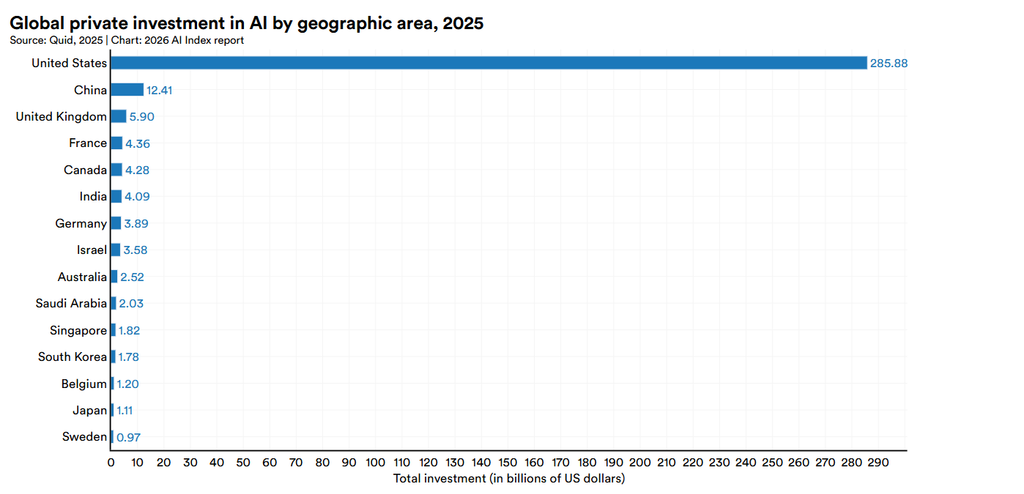
Capital did not spread. It clustered, hardest of all in compute.
The same concentration now shows up in trade data. WTO economists estimate that AI-enabling products drove close to half the growth in goods trade in 2025, and in some regions accounted for as much as 70 per cent of productive investment. A technology story has become a trade story inside a single year.
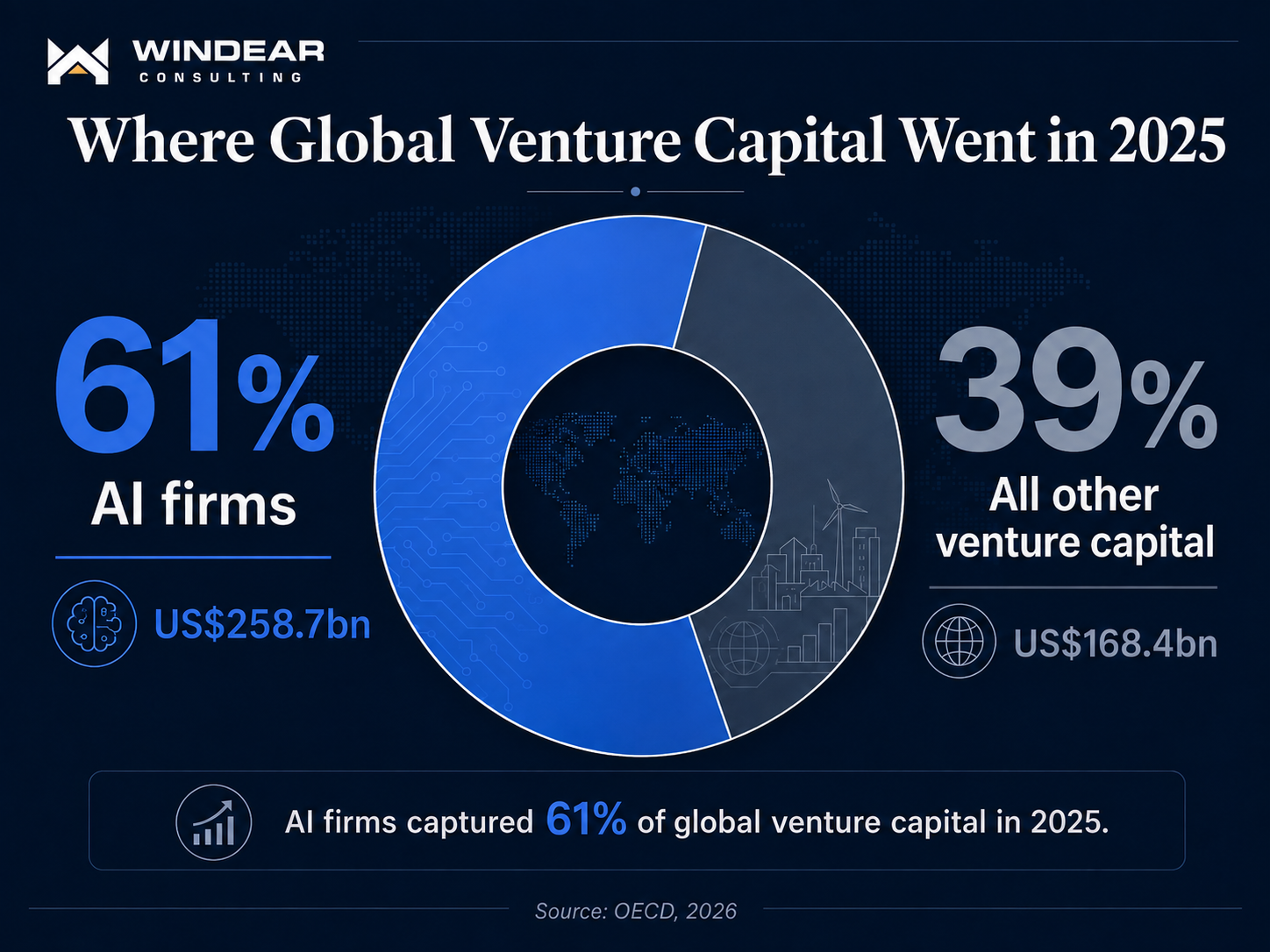
Compute follows the pattern with a sharper edge. Sub-Saharan Africa has roughly 0.4 gigawatts of data-centre capacity relevant to AI workloads, under 1 per cent of the global total, on IMF figures. African installed capacity is projected to roughly triple to about 1.2 gigawatts of IT load by 2030. Over the same period, global capacity is projected to rise from around 82 gigawatts to about 220 gigawatts. Africa’s capacity triples and its share still falls, which is not what a headline about tripling capacity implies. At the financing layer the concentration is starker still. OECD analysis puts AI firms at 61 per cent of global venture capital in 2025, US$258.7 billion of US$427.1 billion. Investors based in the United States accounted for about 56 per cent of AI venture outflows, the United Kingdom 9 per cent, China 8 per cent and EU27 investors 7 per cent.
The binding constraint is power, not chips
Export controls on advanced semiconductors take most of the analytical attention, and for the two principals in the competition that is warranted. For most developing economies it is misdirected. A chip constraint can be relieved by a licence decision. Electricity and technical staffing take a decade.
The IMF models a scenario in which Sub-Saharan Africa holds 0.5 per cent of global AI data-centre capacity by 2035. Reaching even that share would add electricity demand equivalent to roughly 10 per cent of the region’s total installed generation capacity in 2023. Grid connection queues for hyperscale facilities now average more than four years in mature markets. Lead times for generators, chillers and transformers have more than doubled since 2019.
An AI strategy that does not name a power source is a communications document. The policy gap is fiscal before it is institutional. UNCTAD finds that large subsidies and incentives are what is pulling capital-intensive projects in semiconductors, clean energy and data centres toward particular jurisdictions, and that most developing countries cannot match the subsidy programmes of major economies. Where developing states do publish AI strategies, they frequently adopt the normative priorities of Western frameworks, ethics and trustworthiness and algorithmic accountability, without a costed plan for energy supply, technical skills or infrastructure lead times. The result is a strategy that is legible to donors and unimplementable at home.

Where the leverage sits
Demand is dispersing faster than supply is concentrating. That asymmetry is under-exploited.
India offers the clearest working model. The IndiaAI Mission subsidises access to a public compute pool of roughly 18,000 GPUs for domestic startups and researchers, converting a national demand base into negotiated access rather than waiting for the market to provide it. The mechanism is procurement, not aid, and that distinction is what makes it copyable.
The United Arab Emirates is running a different play, positioning itself as an intermediary: capital-intensive stakes in United States technology firms on one side, development and export of large language models for underserved markets on the other, supported by deliveries of advanced Nvidia hardware. Whether that position survives a tightening of controls on onward transfer is an open question. The African Union’s Continental AI Strategy supplies a coordination frame but not a compute pool. A continental strategy with no aggregated purchasing behind it does not change a supplier’s pricing.
Implications for decision-makers
1. Treat compute access as a security variable
For governments and multilateral institutions, access to compute and to foundational technical skills belongs in security planning rather than only in development portfolios. Supporting pooled public compute on the IndiaAI model, and regional capacity in partner states, is cheaper now than managing the consequences of a permanent digital underclass later.
2. Engage the digitally non-aligned on their own terms
A large group of states does not want to select a stack. Technical assistance, interoperability support and data-governance capacity offered without an alignment condition keeps options open on both sides. Conditioning assistance on alignment converts a neutral state into a contested one.
3. Price AI dependency into counterparty risk
As supply chains reorganise around political alignment, a partner’s capacity to operate and secure its own digital infrastructure becomes a credit-relevant fact. Few due diligence frameworks capture it today. Adding it costs little and reprices several relationships.
4. Fund the plumbing, not only the frontier
Vocational training for infrastructure technicians, data engineers and grid specialists is the binding constraint on almost every strategy in this space. Strategic public procurement creates the demand signal that private training provision responds to.
What to watch
- Third-country chip controls – Any extension of United States export restrictions to onward transfer through intermediary jurisdictions, and Beijing’s response. This is the single development that would most change the UAE’s position.
- Regional hubs moving from announcement to operation -Watch for the AU Continental AI Strategy acquiring a financing instrument, and for the UAE’s Global South commitments producing a named deployment with a named counterparty.
- Shared infrastructure frameworks – The World Economic Forum’s multi-stakeholder work on digital embassies, arrangements allowing data to be hosted abroad under negotiated legal protection, is the clearest test of whether shared models can be built without creating new lock-in.
- The MFN share as a fragmentation gauge -WTO economists put the share of world trade conducted on most-favoured-nation terms at about 72 per cent by the end of February 2026, down from 80 per cent in 2024. It remains the cleanest single indicator of bloc formation, and it has a direct technology analogue in bloc-specific standards and compliance regimes. We tracked the trade side of this in The New Geopolitics of Global Supply Chains.
What we do not know
Three questions carry more weight than anything asserted above.
Whether leapfrogging works at this layer. Mobile telephony leapfrogged fixed line because capital intensity fell. AI infrastructure is moving in the opposite direction. Isolated national successes do not establish a pattern, and nothing yet distinguishes India’s position from a well-funded exception.
Whether current alignments harden. Maintaining two incompatible stacks imposes costs on everyone, including the principals. Whether that cost eventually pulls the system back toward interoperability, or whether sunk investment locks the split in, is genuinely open. Whether open-weight models equalise or entrench. They lower the cost of access to capability while leaving the cost of training and serving where it was. Which effect dominates is not yet observable.
What follows
The distribution of AI capability is being set now, by procurement decisions and grid connection queues rather than by summits. For states outside the compute core the practical question is narrow and answerable: what does your demand buy, and who are you negotiating with for it? Most have not asked it, and the answer gets worse the longer the concentration runs.