Energy, trade, food logistics and regional security are moving through the same balance sheets. The task is not to predict one headline; it is to recognise when separate shocks begin to compound.
September opens with geopolitical risk moving through four connected systems at once: maritime energy routes, trade policy, food logistics and West African security cooperation. None is new in isolation. What matters is the speed at which they are now transmitting into inflation, currencies, public budgets, supply contracts and financing conditions.
The World Bank’s June 2026 Global Economic Prospects projects global growth of 2.5% this year as conflict-driven energy costs weigh on the outlook. That baseline is useful, but it is not the operating question. Leaders need to know where pressure can arrive first, what would signal escalation and which decisions cannot wait for a quarterly forecast.
This first Windear Monthly Risk Briefing therefore treats risk as a transmission problem. The mapping below is qualitative: it ranks present pressure and direction, not precise probabilities.
The Opening Risk Mapping
| Risk | Pressure | Direction | Decision horizon |
| Hormuz / energy | Very high | Rising | Immediate |
| Tariff fragmentation | High | Persistent | 30–90 days |
| Black Sea food logistics | High | Rising | Immediate |
| Sahel coordination gap | Elevated | Volatile | 30–90 days |
Windear assessment as at 3 September 2026. Direction is a monitoring judgement, not a forecast guarantee
1. Hormuz is no longer only an Energy Story
UNCTAD’s assessment of disruption in the Strait of Hormuz is a reminder that a chokepoint shock reaches well beyond crude prices. The strait connects energy supply, freight schedules, insurance, working capital and import bills. When traffic becomes constrained, governments and firms feel the effect on different timetables—but they feel the same underlying shock.
The scale of the initial supply impact was exceptional. The International Energy Agency’s April Oil Market Report estimated that global oil supply fell by 10.1 million barrels per day in March, the largest disruption in the agency’s historical series. By 3 September, Reuters reported Brent at about US$97 a barrel and vessel traffic through the strait still below its recent average.
For energy importers, the next-order risks are currency pressure, higher transport and food costs, larger subsidy bills and tighter financial conditions. For exporters, the upside from price may be offset by shipping constraints, insurance costs or political exposure. The same headline can therefore produce very different balance-sheet outcomes.
WATCH NEXT
Daily vessel transits; war-risk insurance premiums; Brent and LNG benchmarks; Qatar and UAE export flows; mediation through Oman and other regional channels.
2. Trade-policy Uncertainty is becoming an Operating Cost
Tariffs are often discussed as a percentage added at the border. That is too narrow. The commercial burden includes rules of origin, classification disputes, export controls, customs delays, retaliatory measures, compliance redesign and the inventory companies hold because policy timing is unclear.
The World Trade Organization’s October 2025 forecast lowered expected merchandise-trade growth for 2026 to 0.5%, while identifying wider trade-restrictive measures and policy uncertainty as downside risks. UNCTAD’s work on trade-policy uncertainty points to the same operational reality: uncertainty can delay investment and reorganise supply chains even before every policy is fully implemented.
The practical question for the next 90 days is not whether global trade stops. It will not. It is which routes, products and counterparties become less predictable, and who absorbs the cost while contracts catch up.
WATCH NEXT
Implementation dates; exemptions and product lists; retaliatory measures; customs guidance; rules-of-origin tests; changes in lead time and inventory cover
3. Black Sea Disruption is Rerouting Food before it Reprices it
Food risk often becomes visible to the public at the retail shelf. Procurement teams see it earlier, in vessel availability, cargo origin, delivery time, quality specifications and financing. On 3 September, Reuters reported that Asian buyers had shifted about 500,000 tonnes of wheat to Australia and Argentina amid Black Sea disruption. Wheat futures were roughly 35% above late-June levels.

For import-dependent governments and businesses, the immediate exposure is not only a higher price. It is also the fiscal and working-capital cost of securing supply from farther away, the risk of mismatched specifications and the political sensitivity of delayed staple-food imports.
The decision window is therefore short. Buyers that wait for a clean price signal may find that logistics, credit or available cargoes have already moved.
WATCH NEXT
Black Sea port operations; charter rates; export availability from Australia and Argentina; wheat tender results; subsidy policy; importer credit conditions
4. The Sahel Coordination Gap is itself a Security Risk
The Sahel’s threat environment is crossing borders faster than regional security architecture is adapting. In April, Reuters reported the first clashes in Niger between West African affiliates of al-Qaeda and Islamic State, with analysts pointing to state-control and coordination gaps. The July 2026 Security Council Report forecast likewise highlighted concern about cross-border spillover and expanding terrorist networks.
This does not mean every coastal West African market faces the same risk. It means that intelligence, border management, trade corridors and crisis response increasingly depend on practical cooperation across the ECOWAS–AES divide. The UN Office for West Africa and the Sahel has continued to warn of regional fragility and the expansion of violent-extremist threats.
For governments and investors, the operational issue is coordination: which agencies are sharing information, which borders and corridors face rising friction, and how external security partnerships affect continuity on the ground.
WATCH NEXT
ECOWAS–AES practical cooperation; border incidents; force deployments; coastal-state prevention measures; changes to trade-corridor access and security protocols.
The Compounding Risk is more important than any one Headline
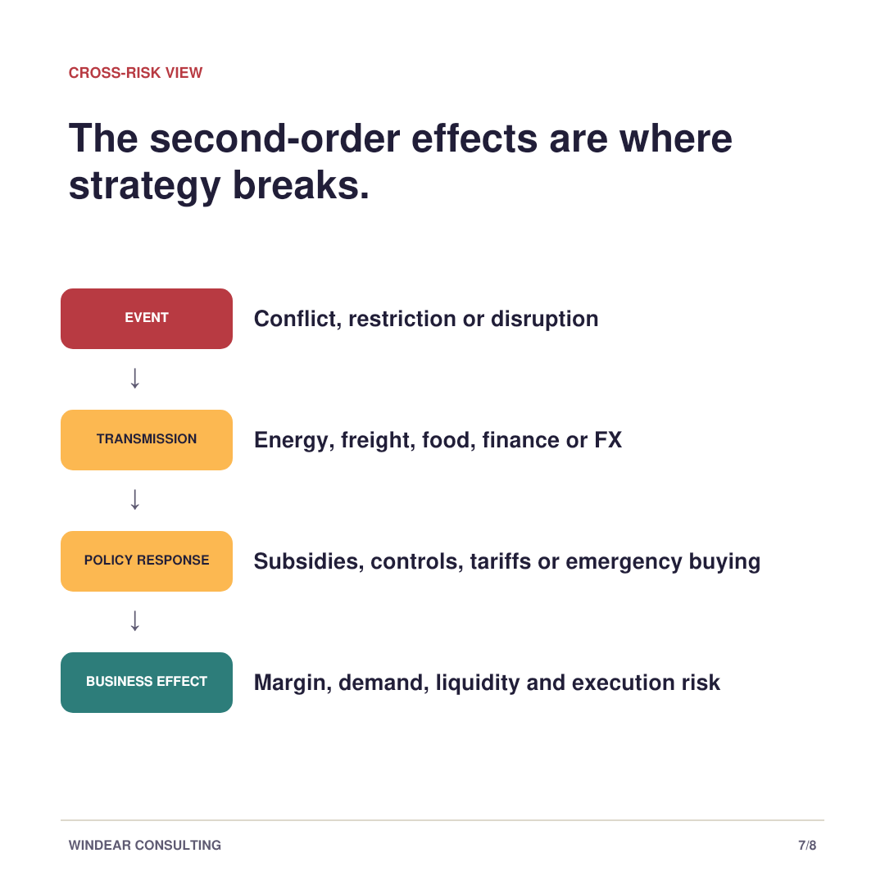
These four risks do not sit in separate boxes. A maritime disruption can raise energy and freight costs. Higher costs can provoke subsidies, controls or emergency procurement. Those responses can strain public finances and foreign exchange. Tighter finances can reduce resilience to food or security shocks. The strategic failure usually occurs in the second or third link of that chain, not at the original event.
What Decision-makers should do in the next 30 Days
- Map first- and second-order exposure. Include energy, freight, food, currency, finance, security and policy-response channels, not only direct suppliers.
- Define triggers before the threshold is crossed. For each material risk, specify the signal, owner, decision and communication route.
- Test substitutes under real constraints. Alternative suppliers or routes must be assessed for capacity, specification, credit, insurance and time, not simply availability.
- Align public and private narratives. Governments, boards, employees, customers and investors should not receive contradictory explanations of the same exposure.
- Review liquidity against the scenario, not the baseline. Model the cash effect of delay, higher input costs, currency movement and emergency procurement together.
Bottom Line
The September risk map is not a forecast of four separate crises. It is a warning that four systems are carrying less slack at the same time. The organisations that manage this quarter well will not be those with the most headlines in their monitoring feeds. They will be those that connect signals to thresholds, thresholds to owners and owners to decisions. Windear helps governments, international organisations and businesses translate geopolitical change into decision-ready analysis. Explore our advisory services or contact the team.
METHOD NOTE
This briefing combines official multilateral analysis, contemporaneous reporting and Windear’s qualitative assessment as at 3 September 2026. It is designed for strategic planning and does not constitute legal, financial, investment or security advice.
Sources for Further Reading
- World Bank — Global Economic Prospects, June 2026
- UNCTAD — Strait of Hormuz disruptions
- IEA — Oil Market Report, April 2026
- WTO — 2026 trade forecast
- Reuters — Oil and Strait traffic, 3 September 2026
- Reuters — Black Sea wheat rerouting, 3 September 2026
- Reuters — Jihadist rivalry spills into Niger, 9 April 2026
- Security Council Report — West Africa and the Sahel, July 2026